
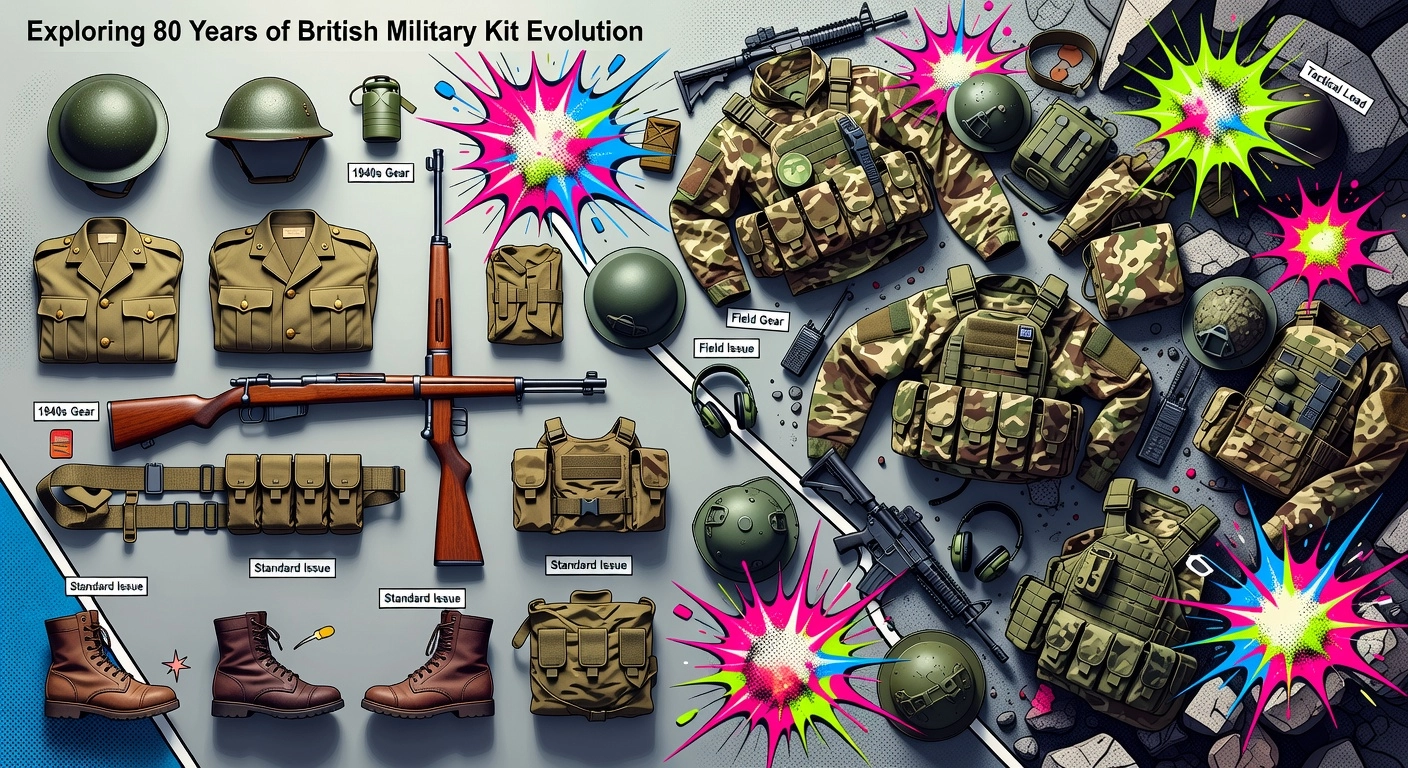
Exploring 80 Years of British Military Kit Evolution
Imagine a British Tommy crouched in the trenches of 1944, his Lee-Enfield rifle slung across battledress webbing designed for endurance amid the Normandy mud. That kit, born of wartime necessity, marked the starting point of an extraordinary journey. Over the next eight decades, British Military Kit has evolved from rudimentary survival gear into a symphony of high-tech precision, reflecting the nation’s military doctrine, technological prowess, and lessons from global conflicts.
This analysis delves into 80 years of transformation, from the post-World War II rationalization of 37 and 44 pattern equipment to the revolutionary Personal Load Carrying Equipment (PLCE) of the 1980s and the modular virtues of today’s Virtus system. Readers will uncover how innovations in materials, ergonomics, and integration with body armor and comms have boosted soldier lethality, mobility, and protection. We examine pivotal shifts driven by the Falklands War, Gulf conflicts, and counter-insurgency in Afghanistan, revealing not just what changed, but why it mattered. Whether you seek insights into procurement decisions or tactical impacts, this exploration equips you with a authoritative grasp of how British Military Kit sustains operational excellence in an era of hybrid threats.
WWII and Post-War Foundations of British Kit
Heavy Wool Serge Uniforms, Hobnailed Boots, and Brodie Helmets
The cornerstone of British military kit during World War II lay in uniforms and footwear engineered for unyielding durability amid the 1940s’ brutal battles. The British Battle Dress, introduced in 1937, featured heavy wool serge fabric that resisted tearing, abrasion, and moisture, proving vital in theatres from Normandy’s mud to Italy’s rugged terrain. This coarse wool provided insulation during prolonged exposure to cold and wet conditions, while its tailored design with reinforced elbows and minimal pockets minimized snags during mechanized operations. Hobnailed boots, known as Ammunition Boots, complemented this with their thick leather uppers and soles embedded with 13 steel hobnails, offering superior grip on slippery surfaces and simple field repairs by replacing individual nails. These boots endured evacuations like Dunkirk and airborne assaults such as Arnhem, outlasting many contemporaries in longevity. The Brodie helmet, a pressed steel design weighing about 2.4 pounds, prioritized shrapnel deflection over ballistic impact, saving countless lives in static warfare at El Alamein. For more on Battle Dress evolution, see British Battledress history.
1937 and 1944 Pattern Webbing Systems
Load-carrying systems evolved through canvas-based webbing to sustain infantry under extreme loads in North Africa and Europe. The 1937 Pattern webbing used khaki-dyed, Blanco-treated cotton canvas with brass fittings, comprising belts, braces, ammunition pouches, and packs that supported up to 56 pounds in marching order. Effective in European campaigns like Normandy, it faltered in desert heat due to water retention and chafing. Responding to these flaws, the 1944 Pattern introduced lighter, rot-proofed canvas in jungle green, with wider braces, quick-release hooks, and larger pouches for better distribution and humidity resistance. Deployed in Burma and post-war Malaya, it enhanced mobility for forces facing guerrilla warfare. Details on its development are available in 1937 Pattern equipment overview. Explore boot specifics at Ammunition boot details.
Transition to Lighter Tropical Gear in the 1950s
Post-war conflicts like the Malayan Emergency demanded adaptations from heavy wool to breathable tropical kit. The 1950 Pattern Jungle Green uniforms shifted to lightweight cotton sateen, reducing overheating in humid jungles while pairing with 1944 webbing for patrols equipped with parangs and first-aid kits. This marked early steps toward synthetics, culminating in the 1958 Pattern webbing’s nylon-canvas blend, which repelled water and lightened loads for operations in Northern Ireland and the Falklands.
Resilience Standards Amid High Casualties
These eras forged benchmarks for kit resilience against attrition rates, with British forces suffering over 383,000 deaths and millions wounded, straining logistics. Wool serge and canvas endured shrapnel, rot, and 50-plus-pound loads, as seen in Tobruk’s 3,000 casualties, emphasizing replaceable components like hobnails. This “last forever” philosophy influenced modular designs, prioritizing survivability in high-loss battles like Normandy’s 65,000 British casualties.
NAO 2023 Inventory Context
The National Audit Office’s 2023 report highlights the Ministry of Defence’s enduring scale, managing 520,000 inventory types and 460 million items worth £11.8 billion annually. Legacy kit principles persist in modern Virtus helmets and MTP camouflage, underscoring vast management challenges. For serving personnel, specialised military kit insurance from Absolute Military protects this evolved equipment, ensuring resilience from WWII foundations to today’s demands.
Cold War Era: 1950s to 1990s Developments
44/58 Pattern Webbing: From Canvas to Nylon Prototypes
Building on post-war foundations, the Cold War era marked a pivotal shift in British military kit toward modular load-carrying systems. The 44 Pattern webbing, a lightweight design from the mid-1940s for jungle warfare, influenced but was largely eclipsed by the 58 Pattern introduced in 1959. This pre-shrunk olive drab canvas system, with anodized aluminum fittings, eliminated the need for blancoing and supported configurations from skeleton order to full combat equipment marching order. It featured ammo pouches for the L1A1 SLR rifle, water bottle pouches, kidney pouches for rations, and poncho rolls. In the Falklands War of 1982, soldiers endured wet conditions by field-modifying the gear, while Northern Ireland patrols favoured belt-only setups for urban mobility. By the 1970s, nylon prototypes emerged, including 1976 butyl trials for NBC resistance, paving the way for full nylon PLCE in the 1990s. For detailed specs, see the 58 pattern webbing entry.
CS95 Uniforms: Post-Gulf War Innovations
The 1990s introduced Combat Soldier 95 (CS95) uniforms, a direct response to Gulf War lessons on breathability and camouflage. Earlier DPM patterns from the 1960s, used in 1960/1968/1985 designs, proved inadequate in desert heat, leading to hasty adaptations like sand-khaki overlays. CS95 unified temperate and tropical variants with refined 1994 DPM featuring IRR coatings to counter night vision, poly-cotton fabrics for moisture-wicking, and layered smocks with hoods. This enhanced versatility for operations in Bosnia and Sierra Leone, reducing visual contrast after wear and improving comfort over predecessors. Historians note it as a “massive upgrade” in field performance. Explore DPM evolution here.
Mk6 Helmet and Ballistic Advancements
Replacing heavy steel Mk III/IV helmets, the Mk6 adopted in 1986 offered superior fragment protection via ballistic nylon construction, weighing 500g less with better comms compatibility. Designed for BAOR exercises and NBC threats, its wider profile improved ergonomics during prolonged wear. Deployed in the Gulf War and Falklands tail-end, it remained standard until the Mk7 in 2009, with reserves using it into the 2020s.
Ancillary Gear for Cold War Readiness
Ancillary items complemented core kit, with 58 Pattern pouches holding 1L water bottles and early med kits including dressings and morphine. Escape and Evasion pouches for Special Forces, NBC haversacks, and 24-hour compo ration rolls supported armoured warfare simulations. These emphasized self-sufficiency amid Soviet invasion fears, as detailed in Absolute Military’s kit analysis.
21st Century Conflicts: Osprey and MTP Gear
Multi-Terrain Pattern (MTP) Camouflage Rollout
The rollout of Multi-Terrain Pattern (MTP) camouflage in the 2010s represented a critical adaptation in British military kit for the versatile demands of 21st-century conflicts. Developed under the Ministry of Defence’s Personal Equipment and Common Operational Clothing programme, MTP modified Crye Precision’s MultiCam while retaining UK Disruptive Pattern Material shapes. It proved superior in trials across the UK, Cyprus, Kenya, and Afghanistan, outperforming woodland DPM, desert variants, and other patterns in visual detection, aerial photography, and user assessments. First issued to the 4th Mechanised Brigade in March 2010 for Operation Herrick, with units like the Royal Dragoon Guards deploying it in Helmand Province by April, full adoption across HM Forces followed by 2013. This pattern excelled in Afghanistan’s Green Zone-featuring compounds, grassland, crops, and woodland-alongside deserts, and translated effectively to Iraq’s urban-desert interfaces. By 2026, MTP remains the standard, seamlessly integrated into uniforms, pouches, and body armour for ongoing hybrid threats. Multi-Terrain Pattern
Osprey Body Armour and Modular Advancements
Osprey body armour, introduced in 2006 after lessons from Iraq’s Operation Telic, evolved through Mk1 to Mk4A to deliver modular protection tailored for high-threat operations. Mk1 built on Enhanced Combat Body Armour with large ceramic plates; subsequent marks added cummerbunds, arm and collar options, improved plate retention, breathable linings for Afghan heat, and expanded PALS webbing supporting 23 pouches. Urgent Operational Requirements (UOR) upgrades optimized it for urban warfare in Basra and Helmand, including low-profile configurations to reduce frontal blast risks, side plate carriers, and drag handles. Paras, Royal Marines, and infantry used ‘Light’ setups for core vest and plates or ‘Complete Fighting Order’ with full accessories, enhancing mobility in close-quarters battles. Over 76,000 Mk4 and 35,000 Mk4A units were produced by 2015. Though transitioning to lighter VIRTUS by 2026-with quick-release pins and Dynamic Weight Distribution-Osprey’s legacy underscores scalable defence in asymmetric fights. Osprey body armour
Shift from PLCE to MOLLE Webbing
The transition from Personal Load Carrying Equipment (PLCE) to MOLLE webbing marked a leap in modularity and load distribution for British military kit. PLCE, rooted in 1989’s 90 Pattern and updated to MTP by 2015, relied on Cordura yokes and pouches for 48-hour sustainment but suffered belt slippage under heavy loads. Osprey’s integration of PALS/MOLLE from 2006 allowed US-compatible attachments over PLCE harnesses, paving the way for VIRTUS in 2015. VIRTUS, standard for high-readiness infantry and Paras, features hip-secured MOLLE belts, 20% lighter pouches, and spine-waist weight transfer, alleviating shoulder strain. This shift supports 45L daysacks and diverse mission profiles, persisting with MTP PLCE for training while dominating deployments. Personal Load Carrying Equipment
Electronics Integration and Kit Valuation
Electronics integration elevated situational awareness, with Bowman communications-fully rolled out by 2008-embedding HF/VHF/UHF radios like the H4855 PRR and PRC354 into PLCE/Osprey pouches for dismounted voice/data in Iraq and Afghanistan. Early night vision devices, with IRR coatings and helmet mounts, complemented these for low-light ops. By 2026, Bowman phases out for AI-capable networks, Morpheus headsets, and sensor-fused tablets, aligning with VIRTUS NVG platforms.
Army Rumour Service (ARRSE) forums estimate per-soldier kit value at over £2,500 in high-threat operations, factoring armour, webbing, MTP gear, and electronics amid Future Soldier reforms. This underscores the need for specialized protection; services like those at absolutemilitary.co.uk offer tailored Military Kit Insurance to safeguard such investments for UK Armed Forces personnel. These evolutions enhance survivability and agility, setting the stage for peer conflicts ahead.
2026 Current Issue: Virtus System and Standards
Virtus Soldier System Breakdown
As of 2026, the Virtus Soldier System stands as the cornerstone of British military kit for close combat personnel across the UK Armed Forces, prioritizing modularity, weight reduction, and enhanced mobility over legacy systems like Osprey. Primarily adopted by the British Army infantry, it sees partial integration in the RAF Regiment for helmets and vests, while the Royal Navy sticks to equivalent MTP gear for boarding parties without widespread Virtus rollout. This system excels in survivability, mobility, and sustainability domains, aligning with NATO standards and delivering over 20-30% weight savings compared to predecessors. For instance, the Virtus helmet, produced by Galvion and NP Aerospace, features a fixed NVG shroud, four-point chinstrap, and sculpted rear for prone positions, weighing 350g less than the Mk7 while meeting HOSDB ballistic standards for fragments and rounds. User feedback from operations highlights improved endurance, though minor retention tweaks continue via 2026 support contracts. The scalable tactical vest (STV) offers configurations from load carriage only to full armour with soft pads and hard plates, available in seven sizes for optimal fit.
| Level | Description | Use Case |
|---|---|---|
| Load Carriage Only | No armour, webbing base | Light patrol/mobility |
| Fragmentation Vest | Soft armour pads | Low-threat frag protection |
| Plate Carrier | Hard plates (front/rear/sides) | Ballistic focus |
| Full Armour | Soft + hard plates | High-threat combat |
Load carriage integrates lightweight webbing with flat-fold pouches, a dynamic spine, and hip belt that shifts 20-30% of weight to the hips, reducing fatigue; a one-day training familiarizes troops. Trends indicate 2026 upgrades targeting cognitive stress reduction amid budget pressures. For detailed specs, see the UK Army’s combat body armour page.
Core Items and Standards
Complementing Virtus, core personal issued gear includes MTP uniforms from the Personal Clothing System (PCS), featuring ripstop fabric with IR reduction for temperate and littoral ops across Army, RAF, and RN. Gore-Tex layers, like the MVP Combat Waterproof Smock, provide lightweight Pac-Lite protection with bellows pockets for wet-cold environments, echoing ECWCS layering. Ballistic helmets default to Virtus models, phasing out Mk7, while hydration systems use 3L Source bladders routed through Bergen packs for hands-free sustainment. Boots (BCHv2), gloves, and eye pro round out essentials, all IR-compliant and multi-cam evolved. Analysis shows these items enhance operational tempo, with 96% soldier approval in surveys for agility gains. Protecting such specialized kit is vital; Absolute Military offers tailored Military Kit Insurance for comprehensive coverage.
Ceremonial Kit for Parades
Distinct from combat gear, ceremonial kit upholds tradition at state events. No.2 Dress service uniforms, in khaki barathea for Army or equivalents for RAF/RN, pair with peaked caps and stable belts for formal duties. Officers carry swords with King Charles III hilts on parades, while Foot Guards don bearskins-tuned black fur caps costing around £2,000 each-for No.1 Dress during Trooping the Colour. These boost morale yet face scrutiny over costs amid inventory cuts. RN and RAF opt for shakos or glengarries.
MoD Inventory Insights
MoD quarterly stats for 2025 reveal management of approximately 520,000 kit types-personal gear subset-across Army, Navy, and RAF, totaling 460 million items valued at £11.8 billion. National Audit Office reports note 25% obsolete stock, driving Virtus modernizations to curb £500 million waste. This analysis excludes major weapons, focusing solely on issued personal equipment. Trends signal scalable protection as key to future readiness. For Virtus insights, explore Source Tactical Gear’s overview.
Future Soldier: 2026 Tech Horizons and Trends
Wearables for Vitals Monitoring, AR Helmets, and AI-Driven Threat Detection
The British Army’s Future Soldier vision positions the dismounted soldier as a networked node, integrating advanced wearables, augmented reality (AR) helmets, and AI-driven threat detection to enhance lethality and survivability. Project Asgard, a £86 million Ministry of Defence contract awarded in early 2026, delivers the Dismounted Data System with radios, headsets, display tablets, and AI-ready sensors for real-time data sharing, enemy identification, and faster decision-making. Trials by the 2nd Battalion Royal Anglian Regiment, in collaboration with the Defence Science and Technology Laboratory, incorporate laser detection for incoming threats, drone thermal imaging, and helmet-mounted strobes for identification. Vitals monitoring wearables track physiological stress, enabling commanders to monitor fatigue in high-threat environments like those observed in Ukraine. AR helmets, while still in development without major UK contracts yet, prioritize situational awareness through data overlays, with Dstl trials demonstrating 20-50% faster threat responses. These technologies align with global trends, where the military wearables market anticipates a 3-12% CAGR through 2030-2035, driven by AI health analytics. For deeper insights into these innovations, explore the Future Soldier Technology 2026 conference.
Rifle Modernization: Project Grayburn and SA80 Replacement
Rifle modernization forms a cornerstone of Future Soldier advancements, with Project Grayburn issuing industry notices in January 2026 for a UK-made replacement of the ageing SA80 series, targeting 150,000-200,000 units by 2030. The new design emphasizes lighter, modular platforms with a common lower receiver supporting five variants, from close combat rifles to cadet models, while incorporating anti-armor rounds like 6.8x51mm to defeat emerging body armor. Integrated features include day/night optics, suppressors, and night-vision compatibility, prioritizing sovereign supply chains for contracts from 2028 to 2045. Potential contenders such as Beretta, Heckler & Koch, and SIG Sauer align with Land 50 warfighting goals, reducing weight and boosting adaptability. This outreach reflects lessons from contested battlespaces, where modularity enhances mission flexibility without compromising firepower.
Self-Healing Fabrics, Energy-Harvesting Materials, and Drone Integration
Emerging materials and drone integration are dramatically increasing British military kit complexity. Self-healing fabrics and polymers in development automatically repair ballistic or micro-damage, minimizing logistics demands in prolonged operations. Energy-harvesting materials, such as solar and kinetic fabrics, power wearables and sensors indefinitely, addressing battery life challenges in extended missions. Drone integration via wearable counter-UAS systems like detection and jamming kits, alongside 3D-printed swarm drones, equips soldiers for near-surface threats, as demonstrated in 2025 RF directed energy weapon trials that downed swarms. These enhancements, building on Virtus and OSPREY systems, elevate lethality by 2-3x through AI and drone feeds in urban warfare scenarios. However, surging complexity demands rigorous maintenance protocols.
UK Weapons Market Growth Amid Equipment Shortfalls
The UK weapons market projects a 3.5% CAGR to 2030, fueled by NATO commitments, yet faces headwinds from the National Audit Office’s 2023 Equipment Plan revealing a £16.9 billion shortfall over 2023-2033, with the Army alone short £1.2 billion. Total defence spending rises to 2.6% of GDP, but unfunded pressures from vehicle extensions and C4I gaps persist. This fiscal strain delays some kit upgrades, even as the broader defence market grows at 3.12-4.09% through 2033.
Rising Kit Values and the Need for Advanced Protection
Per-soldier kit values are projected to rise 20-50% to £20,000-50,000 by 2030, driven by AI, sensors, and drones, amplifying loss risks from theft, damage, or conflict. Modular designs like Grayburn and Asgard cut weight by 10-20%, while next-generation armour and cyber-resilient fabrics bolster survivability; the PPE market eyes 12.7% CAGR to 2033. Military personnel must adopt advanced protection strategies, including specialized military kit insurance from providers like Absolute Military, tailored for UK Armed Forces to safeguard high-value gear and ensure operational readiness. This revolution demands proactive risk management to maintain the warfighting edge.
The True Value and Risks of British Military Kit
The British military kit issued to UK Armed Forces personnel represents a colossal financial and strategic asset, underscoring both its immense value and inherent vulnerabilities. According to the National Audit Office (NAO) 2023 report on Defence Inventory Management, the Ministry of Defence (MoD) oversees approximately 460 million individual items across 520,000 types, with a net book value (NBV) of £11.8 billion as of 31 March 2023. This vast stockpile includes guided weapons, capital spares like aircraft components, and consumables such as munitions and medical supplies. The MoD invested £1.5 billion in inventory purchases during 2022-23 alone, yet challenges like outdated IT systems and overstocked warehouses persist, leading to inefficiencies and potential frontline shortages. These figures highlight how British military kit forms the backbone of operational readiness, but poor management amplifies risks in an era of global instability.
Evolution of Per-Soldier Kit Value
A single soldier’s issued kit, once valued at around £2,500 in 2009, has surged to over £3,500 by 2026 estimates, driven by both general inflation and rapid technological advancements. Adjusting for Consumer Price Index (CPI) rises, the base value climbs 40-60 percent; however, “tech inflation” from upgrades like the VIRTUS body armour system, advanced night-vision optics, and digital communications pushes it higher, potentially exceeding £4,000-£5,000 per infantryman. Components such as the SA80 rifle (£1,000), VIRTUS helmet and armour (£1,500), and optronics (£1,000) exemplify this escalation. Soldier modernisation programmes, valued at £120 million in growth projections through 2035, reflect ongoing investments in networked capabilities. For personnel, this means greater personal stakes in maintaining high-value gear amid deployments.
Personal Liability and Financial Risks
UK Armed Forces members bear direct personal liability for loss, damage, or theft of issued British military kit if deemed due to negligence, with costs recovered through pay deductions or “stoppages.” The MoD covers losses from operational exigencies like enemy action, per established regulations such as JSP 886, but everyday incidents like a misplaced rifle (£1,000+) or damaged armour trigger deductions from wages. Unlike personal effects, which may qualify for compensation, public property kit offers no built-in MoD insurance. This exposes personnel to significant out-of-pocket expenses, prompting many to seek specialised military kit insurance. Providers like Absolute Military offer tailored policies via absolutemilitary.co.uk, covering accidental damage and theft worldwide for as little as £20-50 annually, providing peace of mind without relying on service provisions.
Operational Risks Through AFCS Lens
The Armed Forces Compensation Scheme (AFCS) 2022 statistics reveal the human and equipment toll, with 5,824 injury and illness claims registered in FY 2021/22, alongside 63 survivors’ claims. Of cleared injury cases, 47 percent received awards totalling £93.8 million, dominated by musculoskeletal issues (55 percent), often linked to training and deployments that strain both personnel and kit. These figures contextualise how operational environments accelerate wear, damage, or loss of British military kit, from faulty equipment contributing to incidents to gear abandonment under fire. While COVID temporarily reduced claims, the data signals persistent risks tying personnel safety to kit integrity.
Heightened Exposure from Declining Strength
Declining full-time trained strength exacerbates kit risks, with UK Regular Forces at 125,680 as of 1 October 2025, down 1.4 percent year-on-year and 5 percent over two years per gov.uk statistics. Army numbers fell to 70,300 (-1.5 percent), Royal Navy/Royal Marines to 27,820 (-1.1 percent), and RAF to 27,560 (-1.5 percent), despite intake gains lagging outflows. This shrinkage spreads the £11.8 billion inventory thinner, increasing per-soldier responsibility and logistics strain. Fewer hands mean elevated loss probabilities, stretched maintenance, and readiness gaps, as seen in historical cannibalisation of parts. Personnel face amplified exposure, reinforcing the need for robust personal protections like dedicated kit insurance to safeguard careers and finances.
Protecting Kit with Specialist Military Insurance
Serving personnel in the UK Armed Forces manage kit that holds immense value, as highlighted in prior analyses of systems like Virtus and MTP gear. Yet, this essential equipment faces unique vulnerabilities not addressed by standard home contents policies. Barracks, service family accommodation (SFA), or single living accommodation (SLA) often fail to qualify as a “permanent home,” leaving gaps in coverage for worldwide transit, shared living spaces, and operational hazards. Ministry of Defence (MoD) data underscores the scale: in 2024, 138 laptops were stolen or lost, down slightly from 176 in 2023, with broader government losses exceeding 1,200 devices amid rising operational demands. Personnel risk wage deductions for replacements, as MoD compensation is limited and excludes personal items.
Key Risks Exposed by Standard Policies
Transit damage ranks high among threats, as kit travels frequently during postings, exercises, or deployments via vehicles, aircraft, or ships, suffering from mishandling, weather, or impacts. Standard insurers rarely extend “all risks” protection globally, focusing instead on static domestic scenarios. Theft in barracks or communal blocks targets electronics and valuables; high footfall and shared rooms amplify exposure, with MoD trends showing persistent losses despite security measures. Field operations introduce further perils: harsh conditions like fire, flood, or abandonment during training in the UK or abroad can destroy items, while 2025 expenditure reports indicate surging capital needs for replacements due to intensified commitments. These scenarios demand tailored military insurance to avert financial strain on service members, reserves, and veterans.
Recommended Protection: Absolute Military Kit Insurance
For robust defence, Absolute Military Kit Insurance delivers up to £6,000 standard cover starting from £7 monthly, with worldwide protection encompassing accidental loss, damage, theft, fire, and flood. This policy bridges standard exclusions, safeguarding issued and personal kit during transit and deployments. Customizable tiers via app or online quote suit varying needs, from high-deployment regulars to part-time reserves.
Inclusions and Flexible High Limits
Coverage extends to military uniforms, webbing, boots, ceremonial dress, and swords, alongside electronics like laptops, tablets, and phones. Personal possessions such as watches and jewellery receive specified protection, with single-item limits up to £1,500. Total sums scale impressively: Level 1 at £12,000, Level 2 at £33,500, and Level 3 reaching £69,000, incorporating contents up to £50,000 and £5 million personal liability. Reserves and veterans benefit from adapted tiers for storage or lower-risk profiles, plus extras like £500 for frozen food and £250 for keys.
Mastering Claims and Licence to Occupy Coverage
Claims process with Absolute Military emphasizes efficiency: report incidents swiftly with photos, receipts, and police reports for theft, facing a £50 standard excess (£125 for specified items). Avoid deductions by pre-valuing kit accurately and opting for higher voluntary excess to cut premiums. Crucially, included Licence to Occupy (LTO) provides £20,000 standard for damage to MoD SFA, SLA, or barracks caused by you or family, such as fire or flood; MoD and RAF strongly recommend it, as general policies exclude this liability. Pre-approve alternative accommodation costs up to 30% of contents sum for seamless recovery.
For preparation, consult checklists in A Guide to Armed Forces Kit Insurance, detailing uniforms, electronics, and quote essentials to ensure full protection aligns with your service demands.
Key Takeaways and Next Steps for Kit Management
The evolution of British military kit reflects remarkable progress, from the rugged WWII essentials like heavy wool serge uniforms, hobnailed boots, and Brodie helmets designed for endurance in trench warfare, to the sophisticated 2026 smart modular systems such as the Virtus Soldier System and Future Soldier initiatives. These modern ensembles integrate wearables for vital monitoring, AR helmets, and AI-driven threat detection, transforming soldiers into networked nodes on the battlefield. This shift prioritizes adaptability, ergonomics, and technology over mere durability, enabling UK Armed Forces personnel to meet diverse operational demands from urban conflicts to cyber-enhanced environments.
Key statistics underscore the stakes: the MoD manages an £11.8 billion inventory of kit, with individual personal issue values exceeding £3,500 per service member. High loss risks persist amid trends like increased deployments, rigorous training, and tech upgrades, where damage from environmental exposure or mishandling can lead to substantial claims. Analytical reviews highlight that uninsurable losses often strain personal finances, amplifying vulnerabilities in high-value items like optics and body armour.
For effective kit management, conduct an annual inventory of your personal equipment, cataloging each item meticulously. Photograph high-resolution images of serial numbers and conditions to streamline insurance claims processes. Obtain a tailored quote for military kit insurance at absolutemilitary.co.uk/military-kit-insurance, specifically designed for UK forces to cover these risks comprehensively.
Share your kit management experiences in the comments below, and monitor 2026 MoD updates for emerging standards that could impact your gear. Proactive steps ensure resilience in an era of accelerating innovation.
Conclusion
Over eight decades, British military kit has evolved from the rugged 44 pattern gear of World War II to the cutting-edge Virtus system. Key takeaways include revolutionary advances in materials and ergonomics for superior comfort and durability, seamless integration of body armour and communications for enhanced lethality, and adaptive responses to conflicts like the Falklands War, Gulf campaigns, and modern counter-insurgency operations. These changes have dramatically boosted soldier mobility and protection while reflecting Britain’s unyielding commitment to technological innovation and hard-won lessons.
This exploration equips you with a deeper appreciation for how equipment shapes victory. Dive into a military museum, hunt for replica gear, or share your favourite era in the comments below. The march of progress continues; gear up and stay inspired.